POWERlab / Research / Microfluidic Cooling

Microfluidic cooling of electronics

In-chip liquid cooling co-designed with electronics — achieving unprecedented thermal management for the next generation of high-power, high-density computing. Published in Nature and IEEE Transactions on Power Electronics.

The challenge

Thermal management for the future of electronics

Thermal management is one of the main challenges for the future of electronics. With the ever-increasing rate of data generation and communication, the power density of electronics rises, and cooling has an increasingly large environmental impact. New technologies are needed to efficiently handle the heat in a sustainable and cost-effective way.

Embedding liquid cooling directly inside the chip is a promising approach for more efficient thermal management. However, even in state-of-the-art approaches, the electronics and cooling are treated separately, leaving the full energy-saving potential of embedded cooling untapped.

Thermal management for the future of electronics
Key innovations

Co-designed cooling & electronics

3 breakthroughs
Core concept

Monolithic manifold microchannel cooling (mMMC)

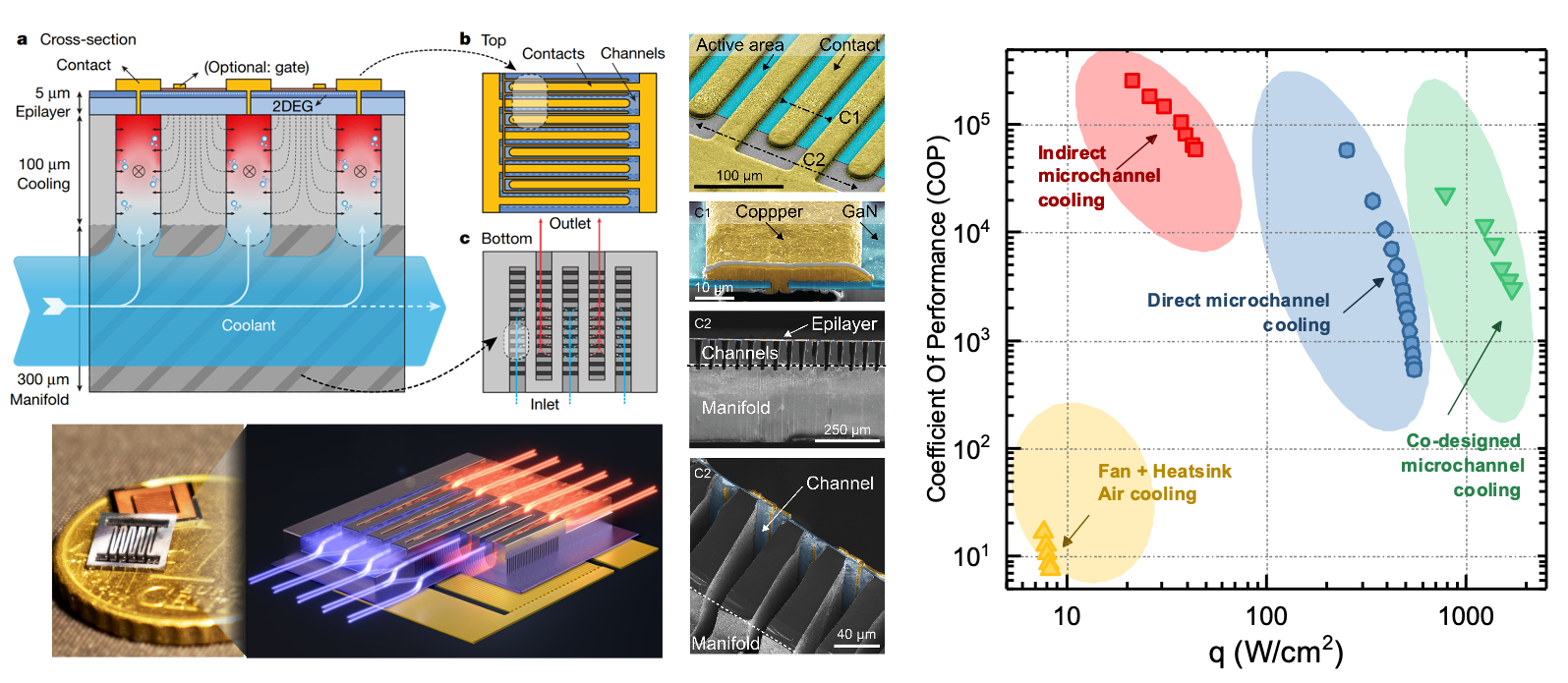
We demonstrated that microfluidics and electronics could be co-designed into the same semiconductor substrate, producing a monolithically-integrated manifold microchannel (mMMC) cooling structure that provides efficiency beyond the state-of-the-art. Our results show that heat fluxes exceeding 1.7 kW/cm² can be cooled down using only 0.57 W/cm² of pumping power. We observed an unprecedented coefficient of performance (>104) for single-phase water-cooling of heat fluxes exceeding 1 kW/cm², corresponding to a 50-fold increase compared to straight microchannels. The proposed cooling technology enables further miniaturization of electronics, potentially extending Moore’s law and greatly reducing energy consumption worldwide.


Featured in
Nature Scientific American IEEE Spectrum New Scientist
Monolithic manifold microchannel cooling structure
Video of our concept
Power electronics integration

In-chip cooling for ultra-compact GaN power converters

The dense integration of GaN power ICs generates concentrated heat fluxes exceeding 1 kW/cm², surpassing the limit of current thermal management. We demonstrated the integration of in-chip microfluidic cooling directly on GaN power integrated circuits, with additively manufactured packaging, to achieve ultrahigh power densities. By considering cooling as a third layer of integration alongside power and logic, we realized a 0.44 kW, 48 V–24 V dc–dc converter in a compact 1/32nd brick form factor. Results show a 14-fold reduction in thermal resistance and a 4-fold increase in total output power compared to heat-sink and fan cooling, reaching an outstanding 78 kW/l power density with power conversion efficiency surpassing 95%. This work paves the way for more efficient and highly compact power conversion to support the electrification of our society.
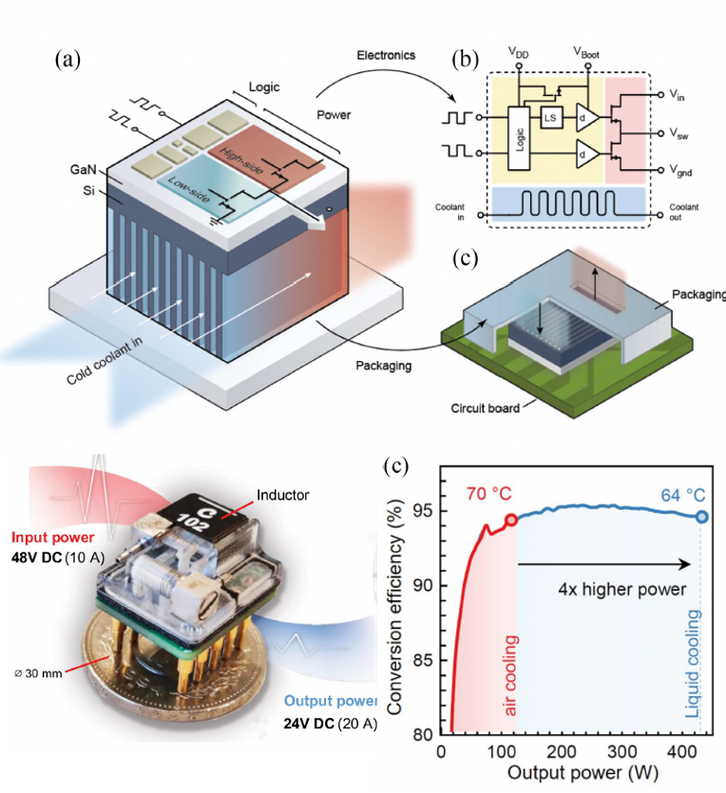
GaN power IC with integrated microfluidic cooling — device, schematic, packaged converter, and efficiency curve
Jet impingement

Flow-guided pin fin design for in-chip cooling

Current in-chip cooling designs suffer from thermally parasitic circulation zones that degrade their performance. We introduced a novel flow-guided pin fin design, embedded directly in the chip, that removes circulation zones through streamlined fin extensions, significantly improving thermal performance. This approach achieves a state-of-the-art thermal resistance of 0.04 cm²·K/W at around 1.5 mW/mm² pumping power — 10× lower pumping power compared to conventional approaches, and much more efficient than intricate monolithic designs. Embedded in a commercial GaN HEMT power IC, the design enabled switching frequencies up to 10 MHz (20 W dissipation) with only 5 mW of pumping power, whereas conventional fan cooling was thermally limited to 3 MHz with 560 mW fan power. A full 48 V–12 V converter employing this design delivered 300 W output power (3× higher than a fan-cooled converter) with only 40 °C temperature rise.
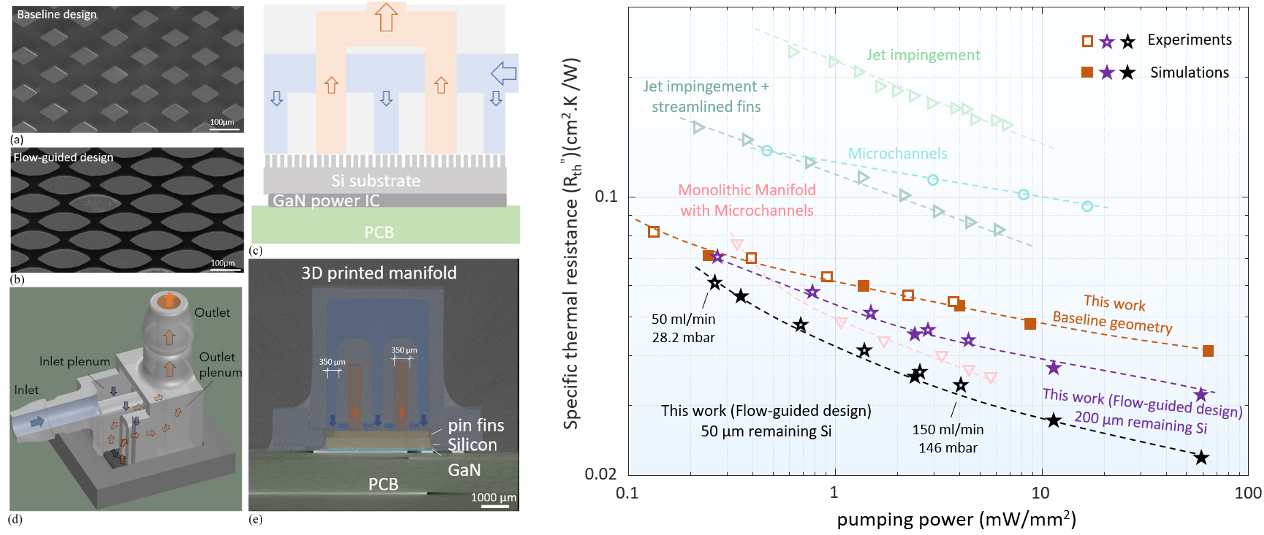

Jet impingement cooling design
Impact & Technology Transfer

Corintis — from lab to industry

This work was published in Nature 2020, received two best paper awards at IEEE ITherm 2020 and Therminic, and was featured in major news outlets including Scientific American, Le Figaro, Le Temps, NRC, IEEE Spectrum, and New Scientist. Together with PhD student Remco van Erp and Sam Harrison, we co-founded the start-up Corintis to commercialize the cooling technology for data centers. Corintis employs over ~50 people and its clients include major datacenter hyperscalers and chip makers worldwide.

Corintis
Selected references

Key publications

2026

I. O. Elhagali, H. Zhu, W. Tang and E. Matioli, “Efficient in-chip cooling integrated with electronics based on a flow-guided pin fin design,” IEEE Transactions on Power Electronics, 2026.

2024

R. Van Erp, …, E. Matioli, “In-Chip Microfluidic Cooling Integrated on GaN Power IC Reaching High Power Density of 78 kW/l,” IEEE Transactions on Power Electronics, vol. 39, no. 8, pp. 9717–9723, 2024.

2020

R. Van Erp, R. Soleimanzadeh, L. Nela, G. Kampitsis and E. Matioli, “Co-designing electronics with microfluidics for more sustainable cooling,” Nature 585, 211–216, 2020.

2020

R. van Erp, G. Kampitsis and E. Matioli, “Efficient Microchannel Cooling of Multiple Power Devices With Compact Flow Distribution for High Power-Density Converters,” IEEE Transactions on Power Electronics, vol. 35, no. 7, pp. 7235–7245, July 2020.

← Back to all research areas