POWERlab / Research / Applications

Nano & microplasma devices

On-chip nano- and micro-plasma devices that enable picosecond switching, non-equilibrium chemistry under ambient conditions, ultrafast probing of correlated materials, and chip-scale THz generation — translating fundamental device breakthroughs into real-world impact.

Core concept

Nanoplasma-enabled picosecond switches

We proposed an on-chip all-electronic device concept based on integrated nano-scale plasma that enabled picosecond switching of high-power electric signals. The devices produced ultrafast switching speed, higher than 10 V/ps, about two orders of magnitude larger than that of field-effect transistors and more than 10-fold faster than the current fastest electronic switch.

These nano- and micro-plasma devices open entirely new application spaces beyond traditional electronics: driving non-equilibrium plasma chemistry under ambient conditions, probing material dynamics on ultrafast timescales, and generating chip-scale THz radiation with record power levels.
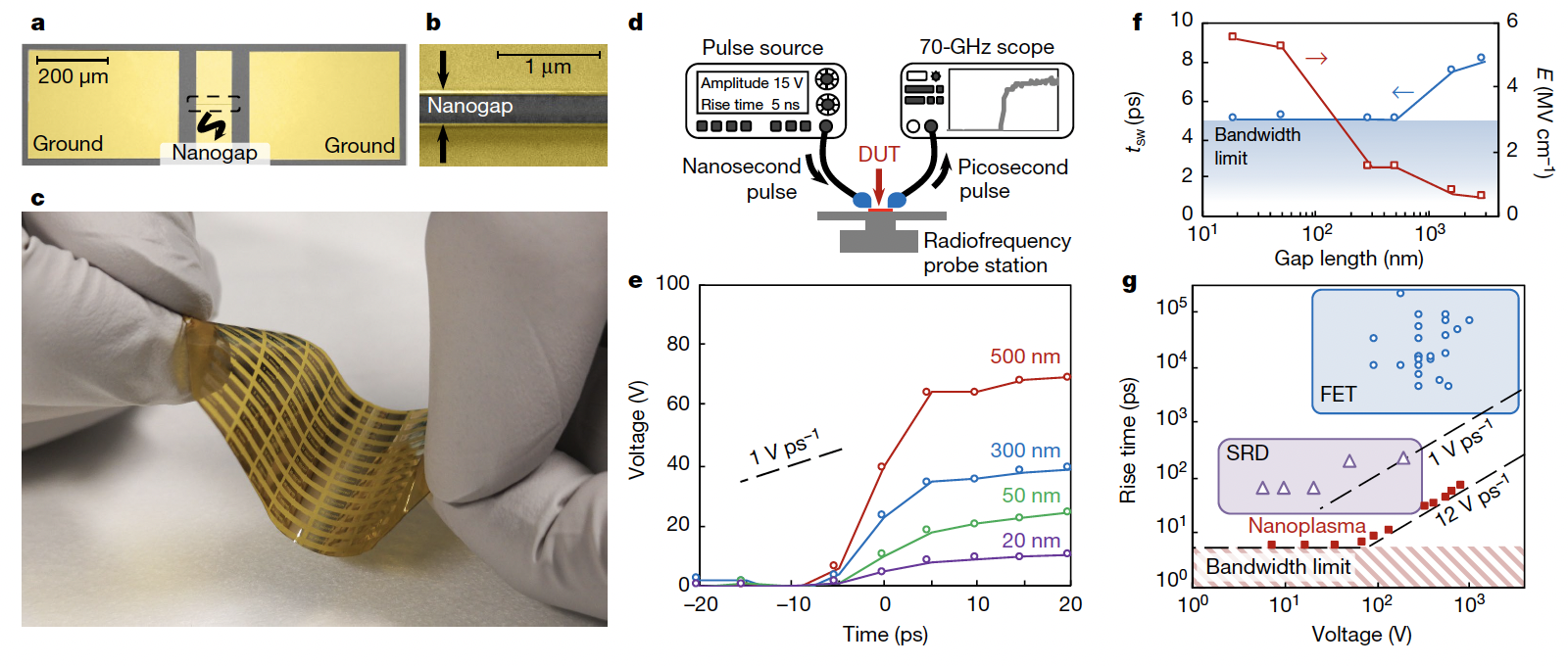
Nikoo et al., Nature 2020 Rezaei & Matioli, IEEE EDL 2024
Nanoplasma switch concept
Applications

Key research directions

2 application areas
Sustainable chemistry

Microplasma for efficient chemistry

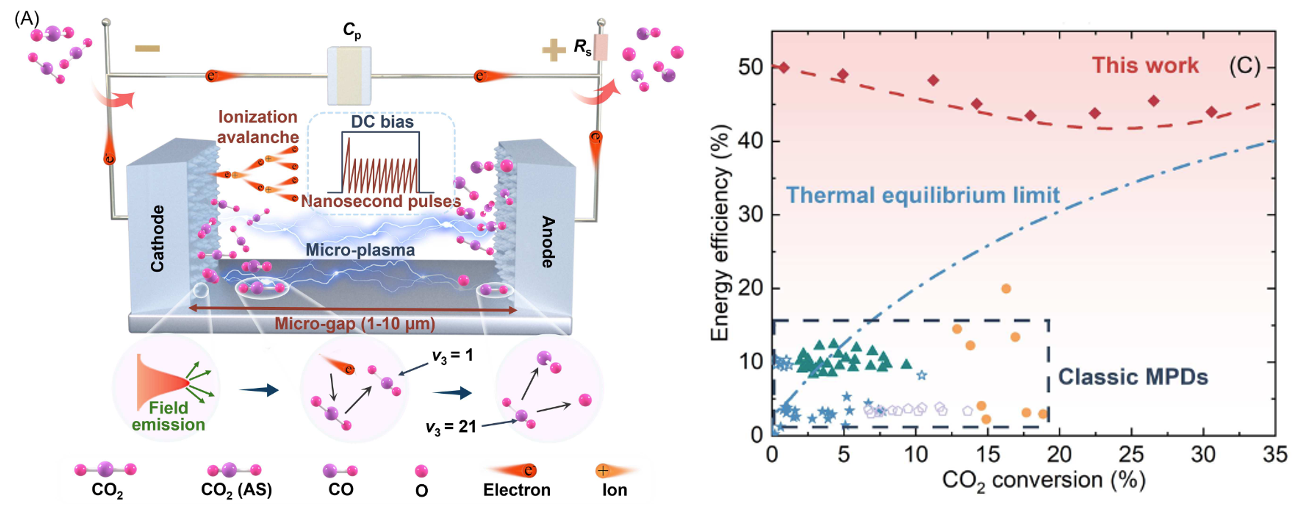
Conversion of CO2 into carbon-neutral fuels and chemicals remains a central challenge in sustainable chemistry and energy, as conventional catalytic processes are critically limited by thermodynamic equilibrium and low overall energy efficiency. Our group introduced a micro-plasma chip for CO2-to-CO conversion that achieves ultra-high energy efficiency and breaks the thermodynamic equilibrium limitation under ambient conditions. These micro-plasma devices (MPDs) with sub-10 μm discharge gaps self-generate nanosecond pulses directly from a DC bias — without external pulsed-power sources — and drive discharges through field emission at substantially lower voltages than conventional plasma systems. The resulting optimized, scaled-up MPD array demonstrates 30% single-pass CO2 conversion and 50% overall energy efficiency without any catalyst — unprecedented among all previously reported micro-plasma systems. Remarkably, its performance exceeds that of many conventional large-scale plasma systems while consuming orders of magnitude less power. Integration of localized on-chip reactive species generation by MPDs with catalytic, synthetic, or electrochemical processes could spur the development of new CO2 reduction pathways.

Micro-plasma device for CO2-to-CO conversion
Materials science

Ultrafast probing of novel material properties

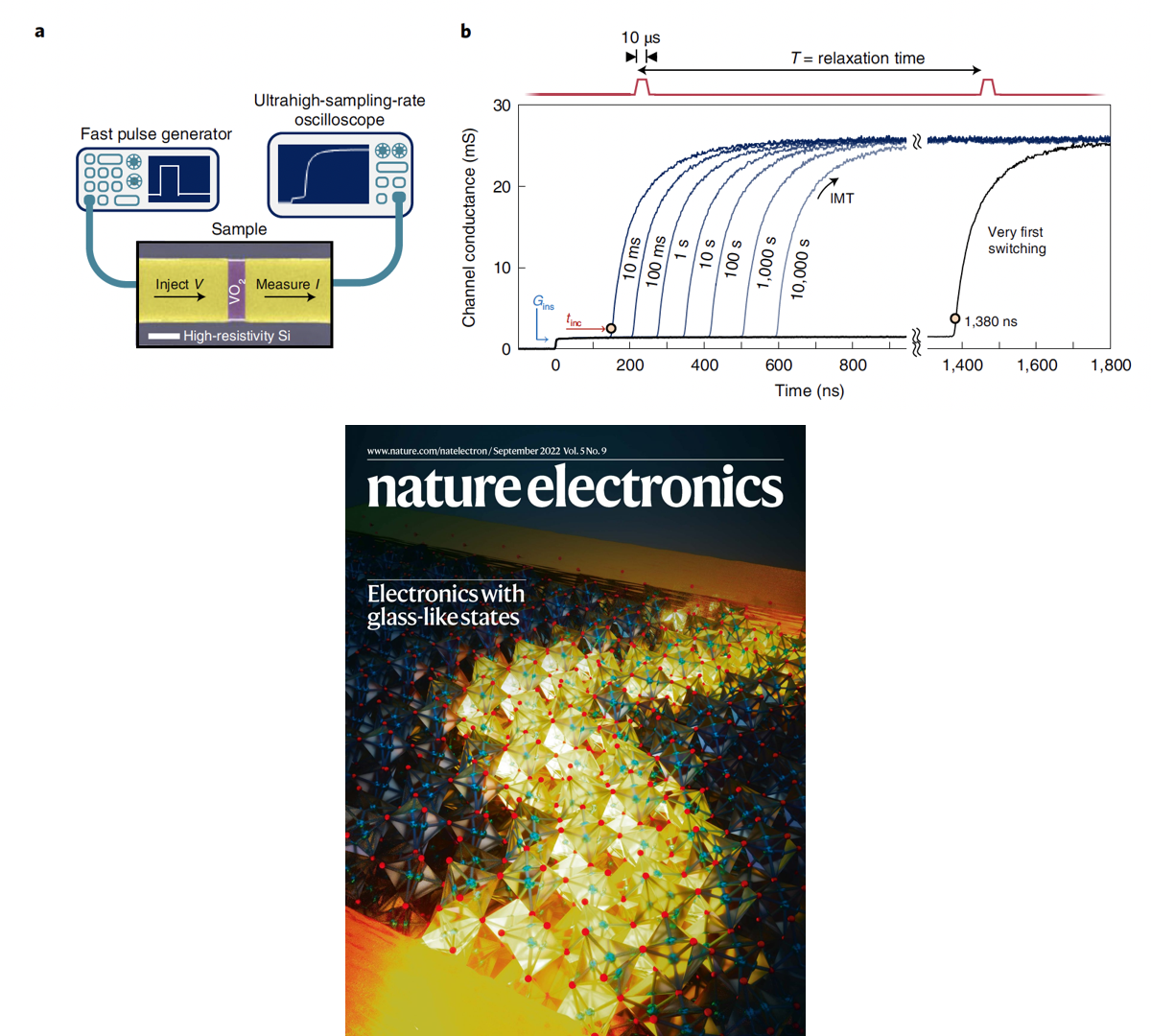
The new methodology introduced by our group can be used for many other fields, for example to understand the fast dynamics in strongly correlated materials. With such ultrafast measurements, we showed that structural states in vanadium dioxide can be arbitrarily manipulated on short timescales and tracked beyond 10,000 s after excitation, exhibiting features similar to glasses. These glass-like functional devices could outperform conventional metal oxide semiconductor electronics in terms of speed, energy consumption and miniaturization, as well as provide a route to neuromorphic computation and multileveled memories.

Ultrafast VO2 measurement setup, conductance dynamics, and Nature Electronics cover
Selected references

Key publications

2026

G. Sun, B. Karakurt, H. Zhu, O. Soydal, J. S. Luterbacher and E. Matioli, “Ultra-High-Efficiency On-Chip CO2 Conversion by Nanosecond Self-Pulsing Micro-Plasma Devices,” Carbon Energy, 2026.

2025

B. Karakurt, H. Zhu, O. Soydal, G. Sun, J. S. Luterbacher and E. Matioli, “Low-Power Tunable Micro-Plasma Device for Efficient and Scalable CO2 Valorization,” Adv. Sci. 12, no. 35, e07687, 2025.

2024

M. Rezaei and E. Matioli, “Chip-Scale Watt-Range Terahertz Generation Based on Fast Transition in Nanoplasma Switches,” IEEE Electron Device Letters, vol. 45, no. 6, pp. 1072–1075, 2024.

2022

M. S. Nikoo, R. Soleimanzadeh, A. Krammer, G. M. Marega, Y. Park, J. Son, A. Schueler, A. Kis, P. J. W. Moll and E. Matioli, “Electrical control of glass-like dynamics in vanadium dioxide for data storage and processing,” Nature Electronics, 2022.

2020

M. S. Nikoo, A. Jafari, N. Perera, M. Zhu, G. Santoruvo and E. Matioli, “Nanoplasma-Enabled Picosecond Switches for Ultra-Fast Electronics,” Nature, 2020.

← Back to all research areas